


In Alison’s world, music has never been a side path. It has been the constant thread – paused, rerouted, re-found, and ultimately returned to with, in her words, “a vengeance.”
Her new album, Coming Out Alive, arrives after a long creative silence, a life coaching chapter, and a personal process of rediscovery.
We spoke about the journey behind the record, Alison’s writing process, and her long-standing relationship with Yamaha Guitars
Before your break from music, where were you at in your career – and what led you to step away?
“I’ve never even questioned that I should do anything other than music,” she says. “And I think that’s one of the reasons I did as well as I did… I never had anything else to go by.”
But that singular focus came with its own pressure.
“Being a musician is sort of a renegade thing,” she explains. “It’s not the easiest path to make a living, put food on the table for your family, and pay your mortgage and all that stuff.”
Eventually, even her success began to feel misaligned. Opportunities were there, but something wasn’t right.
“I was so burned out and so depressed,” she says. “The more beautiful the music I wrote, the more sad I would get. It was like… there was obviously something wrong.”
At a key moment, faced with a major opportunity scoring a TV series for Discovery, she chose differently.
“I just felt like I had nothing to give,” she recalls. “I had to turn it down.”
That decision marked the beginning of a complete reset.
What did that break look like?
Alison didn’t just step back from the industry, she stepped away from music entirely.
“I stopped playing guitar. I stopped playing piano,” she says. “I just went out in the world.”
That shift opened the door to something new.
“I discovered life coaching and that was amazing,” she explains. “I went to school for it and got trained, which gave me so much more inner strength.”
It offered a completely different perspective.
“As a musician, it’s very self-focused: ‘what do I want?’, ‘what do I need?’,” she says. “But coaching is the opposite, you don’t have an agenda. That was so refreshing for me.”
At the same time, she began to find something even more personal: community.
“I started going to discussion groups and meeting people who were trying to understand where they fit in the world,” she says. “And then I discovered that I’m trans.”
That moment brought clarity.
“It was like a missing puzzle piece in my life,” she explains. “I realised my ‘special weirdness’ had a name.”
Being around others with shared experiences was transformative.
“I went to trans pride and I just felt at home in a way I never had before,” she says. “It was so liberating.”
Alongside all of this, there was also movement – literal and creative.
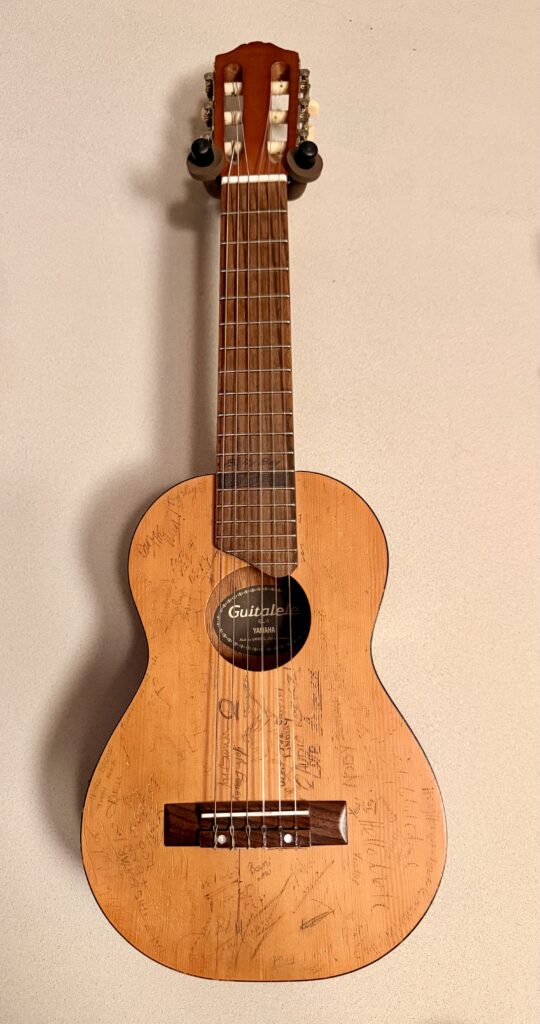
“I took a Yamaha Guitalele, put it on my back, and travelled by train up the West Coast, across Canada, down the East Coast, and ended up in New Orleans,” she says. That small instrument became a companion and a canvas.
“I’d hand it to people and have them sign it with their signature,” she says. “It became this thing that carried all these moments with it.”
Without pressure or expectation, she kept capturing ideas.
“I had about 250 voice memos on my phone,” she says. “Just little pieces, ideas, things I’d played along the way.”
At what point did music start to call you back again?
“I promised myself I wouldn’t go back to music until I loved it again like I did when I first started,” Alison says.
That moment eventually arrived.
“All of a sudden, I was like, ‘Oh, I want to write those tunes,’” she recalls. “And that was what I needed.”
What was your writing process like when shaping the album?
“I had all the voice memos,” she says. “So, I went through them and started grouping them together.”
What began as fragments quickly became something bigger.
“I ended up with about 60 pieces, then narrowed it down to 25, and then 10 made it onto the album,” she explains.
More importantly, the intention had shifted.
“I’m not writing this for a music supervisor,” she says. “I’m writing this for me.”
Coming back to that process after years away felt natural.
“It wasn’t about trying to force anything,” she says.
You’ve had a long relationship with Yamaha – tell us about how that began, and which guitars featured on the album.
Alison’s long relationship with Yamaha stems back to 1989, “I had just moved to LA… and I entered the Southern California Guitarist of the Year contest,” she recalls. “Yamaha Guitars’ Ken Depron was one of the judges… Jennifer Batten, and Steve Lynch were among the judges. I plugged my acoustic guitar into an amp stack and played my tune Snapdragon.”
That performance didn’t just land well, it connected Alison to people who would shape her path.
“Ken remembered me from that,” she says. “And later, at a Yamaha event, he came up to me and said he’d seen me at the contest.”
From there, things moved quickly. A chance encounter at NAMM, where she manged to sneak in without a badge, led to introductions that would begin a long relationship with Yamaha.
“I went to see Yamaha and the staff on the booth said, ‘We need to get you into some of our guitars!’”
Alison has built a vast collection of Yamaha guitars since then, including three APX series guitars (including one 12-string), an L-series cedar-top acoustic (“one of the nicest guitars… I love it”), a custom shop, large orange flake electric baritone, CSF-TA TransAcoustic, A3CM, and her beloved Guitalele.
The latter three were her guitars of choice on the new album, all serving a purpose.
At the heart of the record, featured on most of the songs, is her Yamaha AC3M.
“I like it because it’s really well made, it feels great, it’s consistent,” she says. “It’s got a pickup that really captures the tapping”, she explains. “That’s something I’ve always needed.”
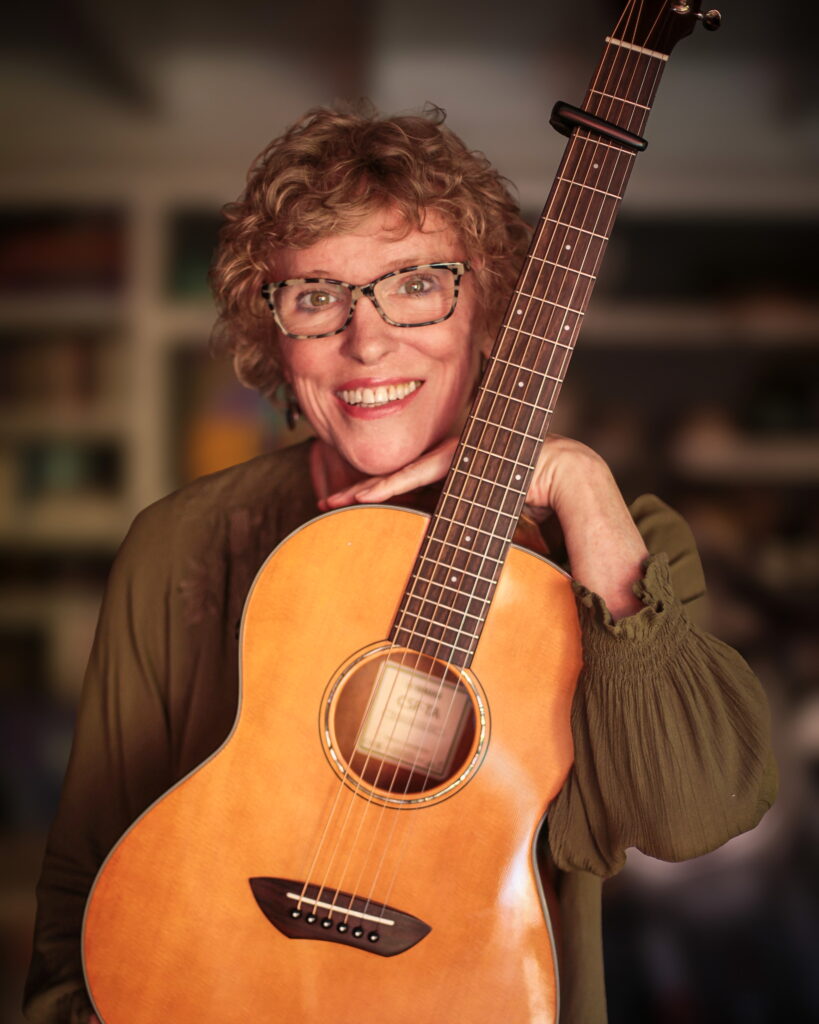
The smaller-bodied CSF-TA TransAcoustic preferred partly due to her time writing on a more compact instrument.
“After playing the Guitalele so much, a full-size guitar felt big,” she says. “So, the smaller scale just made sense.”
And then there’s the Guitalele itself, “that could be my desert island instrument,” she says. “It’s so versatile, so tough, you can take it anywhere.”
Reflecting on the finished record, what would you like people to take away from it?
“I’d like people to feel the joy,” she says.
That joy is something she had to rediscover, not just in music, but in herself.
“The title is about that whole process,” she explains. “Coming out of being burned out, going through everything I went through… and then coming out alive on the other side.”
“There’s a playfulness, an adventure in it,” she says. “that comes from loving it again.”
Ultimately, the album stands as both a return and a celebration.
Enjoy the album here:
https://www.pandora.com/artist/all-songs/alison-whiteacre/AR22rXtqlrhZkpq
https://music.apple.com/us/album/coming-out-alive/1889755497
https://alisonwhiteacre.bandcamp.com/
You can also check out Alison’s first two singles/videos here:
The Fake McCoy: https://www.youtube.com/watch?v=PevPmuG3tEs
The Lively Maiden: https://www.youtube.com/watch?v=GU2YUo3ftB4
Socials:
YouTube: https://www.youtube.com/@AlisonWhiteacre
TikTok: https://www.tiktok.com/@AlisonWhiteacre
Instagram: https://www.instagram.com/alisonwhiteacre